


Aligning interests to boost trust, and ultimately sales, in used-car protection
Buying a used car is a high-stakes moment for customers, often amplified by uncertainty about a vehicle’s condition. In France, Stellantis Financial Services and BNP Paribas Cardif, through their respective subsidiary Stellantis Insurance & Icare, have partnered to support the Spoticar label with a unified suite covering warranties, maintenance and specific electric vehicle protection.
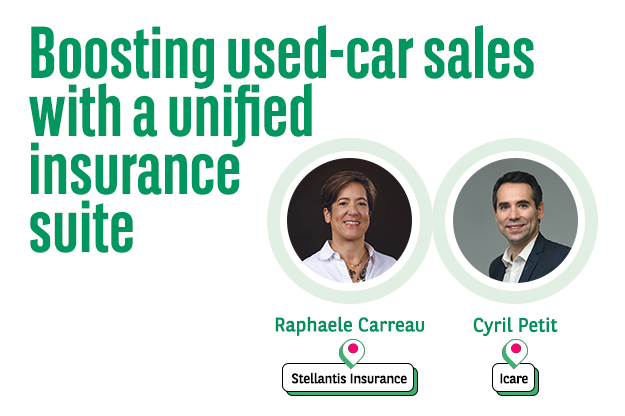
Raphaele Carreau, Global Head of Stellantis Insurance, and Cyril Petit, Global Head of Mobility at BNP Paribas Cardif and CEO of Icare, explain how the partnership was designed to reassure buyers, simplify dealers’ day-to-day operations, and scale performance across the network.
What was the situation before the partnership; what were the key barriers to customer confidence in used cars, and what did dealers need most?
Raphaèle Carreau (Stellantis Insurance): No – the foundation already existed. Stellantis had established used car warranty and extended warranty products. What we needed was a step up in operational efficiency and service quality, supported by tools that are both competitive and effective.
Cyril Petit (Icare): That is a crucial point. This is not “just an insurance product.” It is an end-to-end industrial chain that must be fully integrated into the dealer sales journey and day-to-day operations to deliver real value and be relevant.
You chose a partnership model rather than a classic supplier relationship. What philosophy guided that choice?
Raphaèle Carreau: For me, the partnership model matters because it aligns interests. When all parties share the same performance logic and risk exposure- when everyone has ‘skin in the game’– service quality improves as a direct consequence.
Cyril Petit: It also transforms how people work together. We experience it everyday: we operate as one joint team across the entire value chain, combining the skills of each party to achieve the best possible outcome.
When you say “alignment” and “skin in the game,” what does that mean in practice?
Raphaele Carreau: It means establishing a clear principle from the outset: sharing value fairly pooling expertise with the humility to recognize what each partner does better.
Cyril Petit: It also means sharing outcomes. If we get it wrong, we share the consequences in a balanced way. And if we get it right, we share success in the same way. That is what makes the relationship fundamentally different.
What were you looking for in a partner, and what did each of you bring to the table?
Raphaele Carreau: There is a long-standing history of collaboration between Stellantis and BNP Paribas including between Stellantis Insurance and BNP Paribas Cardif, with Icare having previously partnered with Credipar in France. Concretely, we were looking for proven expertise in mechanical warranty products, with a longer track record than ours, as well as tools and operations already running at much higher volumes. The objective was to achieve operational efficiency, which in turn drives economic efficiency.
Cyril Petit: What makes the set-up powerful is having the entire ecosystem around the table: the dealer, network the manufacturer, the finance “arm” the insurer. This allows us to look at each topic end to end, from product and distribution to financing and insurance, and to close the loop on decisions across the full value chain. We then co-constructed the solution through joint workstreams across product, pricing and operations, selecting what works best based on each party’s strengths.
What changes for dealers in daily operations, very concretely?
Raphaele Carreau: It has been a continuous evolution rather than a revolution, consistently focused on making processes simpler for dealers. The experience is now more seamless and better integrated. We improved interfaces and integration into dealer tools – across sales, after-sales and management – and raised the bar on service quality, in particular regarding responsiveness, processing times and payment timelines.
Cyril Petit: Our goal is for the claims journey to feel smooth and fast across the entire network. When a dealer contacts us, we align on a first diagnosis within minutes, and if the invoice matches what was agreed, payment follows quickly. The ideal outcome is a process that is so fluid that it no longer generates complaints
Why will the electric vehicle (EV) battery cover be important to include very soon?
Raphaèle Carreau: EVs already represent a significant share of new registrations, and for used-EV buyers the battery can be a source of concern. Adding battery cover directly addresses that anxiety and supports Stellantis’ broader transition to electric mobility. From an insurer’s perspective, EVs come with far less historical data than combustion vehicles – and actuarial work depends on robust data. Partnering with Icare, which brings deep technical expertise, and with Stellantis as the manufacturer, enables us to pool the data needed to design a more relevant product.
We are only at the early stages of the EV movement: technology evolves quickly, and the product range will have to adapt quickly too. This partnership allows us to combine data and expertise to continuously refine and enhance the offer over time.
How will you measure success in the first months, and what should it look like by year-end (2026) ?
Raphaèle Carreau: The first and most visible metric to follow is the number of dealers joining the program, as this is a clear sign of trust. We then will track: commercial volumes, warranties, extended warranties, maintenance products. We will also track operational KPIs such as handling time, payment timelines, responsiveness, and the network’s feedback, which should include a substantial decrease – and, ideally, the full disappearance – of negative feedback. Indeed, our network satisfaction surveys should show that the program has been improved and that it makes sense for dealers to join.
Cyril Petit: For us, a key milestone is reaching the full scope we set for ourselves. By the end of 2026, the program should be fully deployed, allowing us to verify -with concrete results – whether we have met, or exceeded the objectives we agreed together.


